
Mooring a pontoon against a wall sounds simple, but it’s one of the details that most affects how safe and usable the platform is. If the pontoon can’t move with the water or can move too freely, you end up with a working platform that’s uneven, unstable or both. This guide explains the problem and the main ways of solving it.
Why Is Mooring a Pontoon Against a Wall Tricky?
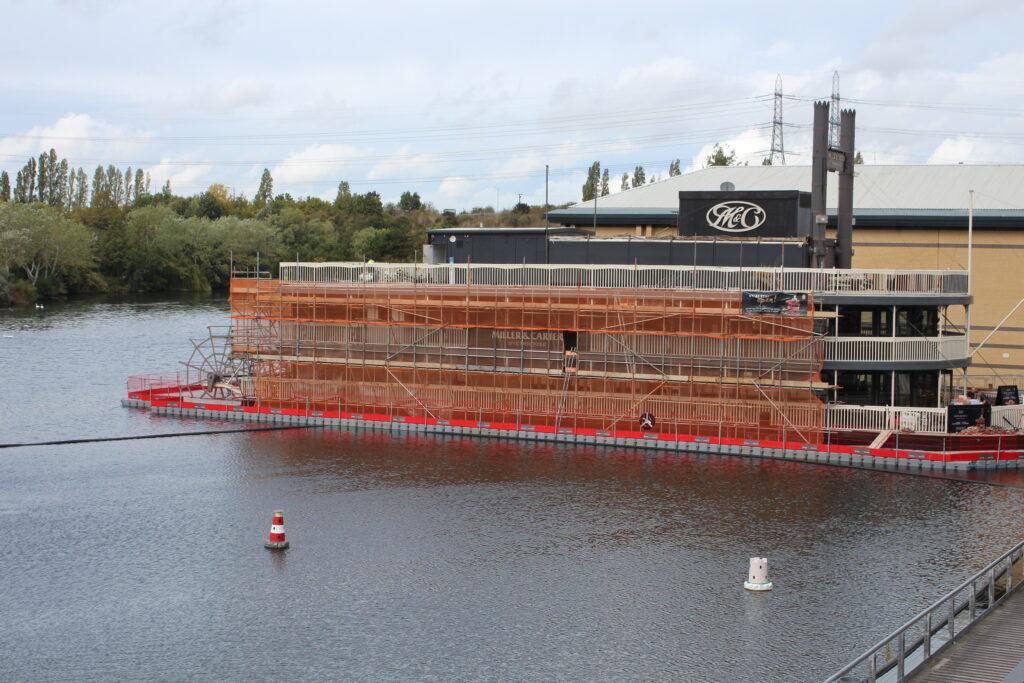
A pontoon floats, so its height changes with the water. A river wall doesn’t move. If the pontoon is tied tight to the wall with short, fixed lines and the water level drops, the pontoon can end up hanging from its lines rather than floating. This tilts the deck, which matters most when the platform is carrying something that needs to stay level, such as a scaffold.
The mooring, therefore, has two jobs that pull in opposite directions: hold the pontoon in position against the wall and let it rise and fall freely with the water.
Option 1: Weighted Chains
One effective method is to use weighted chains. Each chain is secured to a fixed point set back from the wall, such as a concrete block, then passed over the edge of the wall and through an eyelet on the pontoon. A weight is then added below the waterline. The weight keeps the chain taut, pulling the pontoon gently towards the wall, while the chain slides through the eyelet as the water rises and falls.
This works well where the wall can’t be drilled or fixed to and where the platform needs to stay level through changing water levels. The trade-off is that moving the pontoon along the wall takes a little longer than undoing a simple line. That’s why it often makes sense to use a longer pontoon on these jobs, so it needs repositioning less often.
Option 2: Rings, Guides and Pile-Style Restraint
Where there’s a structure on the pontoon that can be tied back to something fixed, such as a scaffold tied into the building, rings or guides can act like a pile guide. They restrain the pontoon sideways while letting it move freely up and down. This is a common approach for scaffold platforms.
Option 3: Ground Anchors and Ratchet Straps
On sites with suitable anchor points on the bank, ground anchors with ratchet straps run back from the pontoon and can provide secure, adjustable restraint. The straps can be set to allow for the expected movement in water level, and they’re quick to install and remove. This depends on there being sound anchor points available, so it’s always subject to the final site arrangement.
Protecting the Wall
Where the wall is historic or sensitive, the mooring has to avoid fixing to it at all. Fenders between the pontoon and the wall protect the stonework from contact, and a mooring system that holds the pontoon in place without drilling or fixing to the structure keeps the wall untouched.
What Affects the Right Mooring Choice?
The best arrangement depends on the site, and it’s worth thinking about the following early:
- How much the water level is expected to change, and how quickly
- Whether the wall can be fixed to or must stay untouched
- What’s on the pontoon, and how sensitive is it to the deck tilting
- Where anchor points or fixed structures are available
- How often the pontoon will need to move along the wall
FAQS
How do you stop a pontoon drifting?
A pontoon is held in place with a mooring system matched to the site, such as weighted chains, ground anchors with ratchet straps, or guides tied to a fixed structure. The right choice depends on the water, the wall and what’s on the pontoon.
Can a pontoon be moored without fixing to the wall?
Yes. Weighted chains secured to fixed points set back from the wall, or ground anchors on the bank, can hold a pontoon against a wall without drilling or fixing to the wall itself.
What happens to a pontoon when the water level drops?
A correctly moored pontoon lowers with the water. If it’s tied too tightly to a fixed structure, it can end up hanging from its lines, which can tilt the deck.
Can a pontoon be moved along a wall during a project?
Yes. Modular pontoons can be repositioned as work progresses, though the mooring method affects how quickly. A longer pontoon can reduce the number of moves needed.
Get a Quote
If you need a pontoon moored against a wall or bank, get in touch with our team with your site details and we’ll talk through the mooring, loading and access. We cover the whole of the UK. Call today on 01590 607104 or email us at admin@floatingpontoonhire.co.uk